Oakdown Holiday Park · Sidmouth · East Devon
Looking after this corner of Devon
Eco friendly holidays in Devon
Two generations of caring for the land — and the David Bellamy Conservation Gold Award every year since 1996.

Our family has farmed this land for two generations. That is not something we say as a marketing line — it is the reason we care so deeply about how this landscape is looked after.
Long before sustainability became a buzzword in tourism we were planting trees, managing hedgerows, building bug hotels and treating our water naturally through our Victorian Reed Bed, keeping chemicals off this ground wherever we possibly could. This page sets out what we do and why — and what it means for your stay here in East Devon.
Recognised for
Our environmental awards
- David Bellamy Conservation Gold Award — every year since 1996. Thirty years.
- AA Five Star Platinum Pennant — one of the few in East Devon.
- Practical Caravan Best Pet Friendly Site — 2026.
- Tripadvisor Travellers’ Choice — 2025 and 2026.
- Visit Devon Tourism Gold — 2017.
Want the full story behind our awards? See everything the park has been recognised for over the years.
Wild at heart
Nature and wildlife
Trees are at the heart of everything we do at Oakdown — our name is no accident. We work to an environmental planting plan that protects the trees and plants already here, encourages new species to establish and makes sure any damaged or dying trees are replaced. We have counted 66 varieties of tree on site and 57 wildflower species.
We provide bird boxes, feeding tables and hand built homes for insects throughout the grounds, including two new bug houses that have quickly become popular with guests and wildlife alike. Tree prunings are chipped and used as mulch across the park, suppressing weeds naturally and reducing the need for chemical weed control. Grass cuttings go to the family’s farmland rather than to waste.
There are areas around the park we purposely leave unmown — our wildflower areas, where nature takes its course and the bees and other pollinators do their work.

Along our dog walking trail we have placed small plaques identifying the flora growing naturally there, with rubbing plaques for younger guests to use — a small way of helping visitors connect with the landscape they are walking through.
Wildlife on the doorstep. Trail cameras on site have recorded deer, badgers, owls and a good range of local birds — evidence that careful land management over many years is paying off. There is more on our bird hides and wildlife page. The field trail has its own page too.
A blooming marvellous day
Thirty years of the David Bellamy Gold Award
On 23 June 2004 the late Professor David Bellamy came to Oakdown to officially open Oak Mead, our nine hole golf course. It was quite a day. Representatives from the BH&HPA — now HARPA — arrived by helicopter and landed on the course itself, before David drove in to declare Oak Mead open.
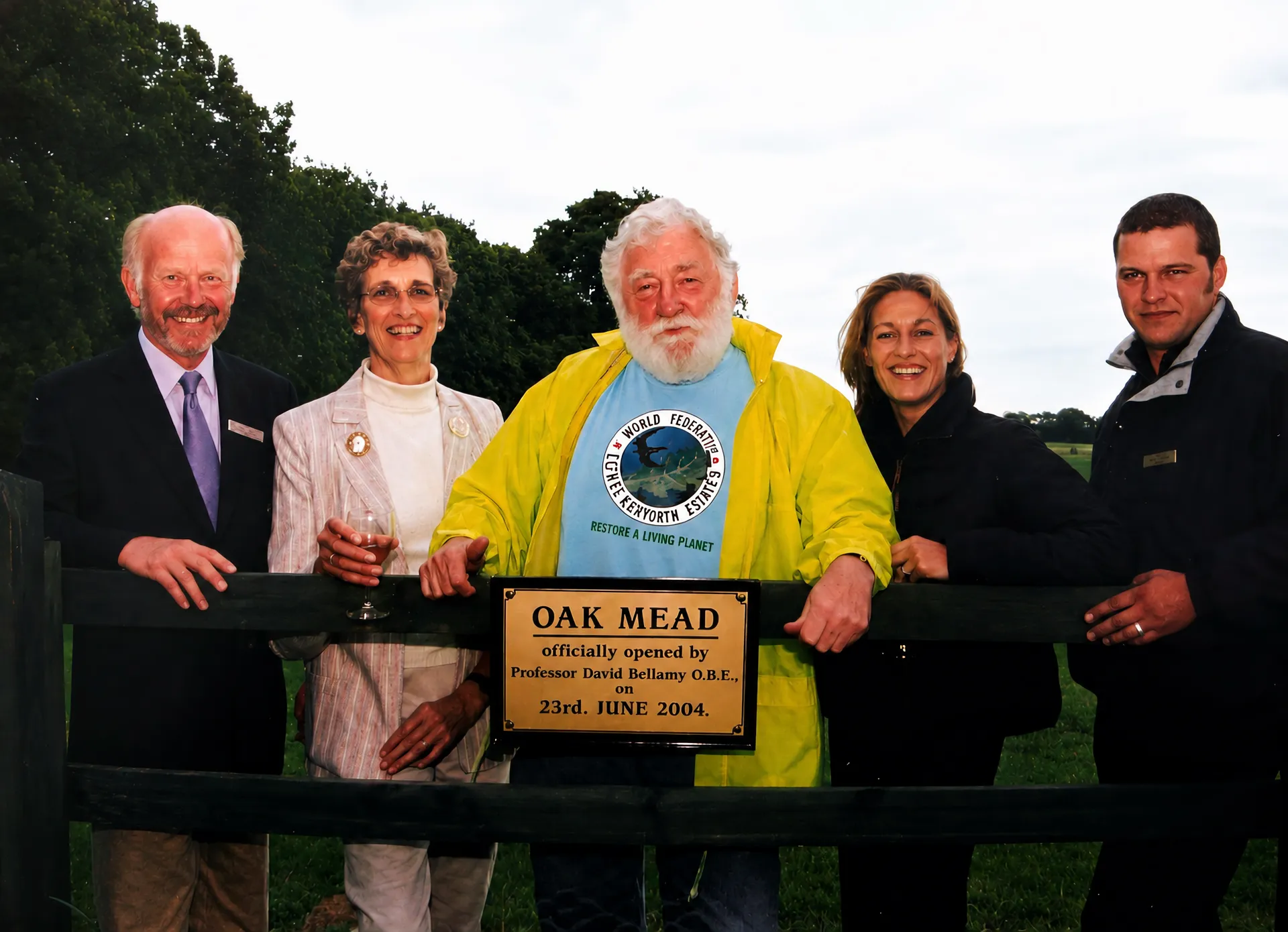
His visit meant a great deal to us. David spent his life encouraging people out into the countryside to value the wildlife and the landscape around them — the same instinct that has shaped how we look after this corner of East Devon for two generations.
We have held his Conservation Gold Award every single year since 1996. Thirty years on, that unbroken record is the credential we are proudest of. It is not a certificate that gathers dust — it reflects work we carry on every season, from the Victorian Reed Bed to the wildflower areas we leave for the bees.
David later sent us a signed message, singling out one feature for particular praise:
“Gold — congratulations, you are doing a wonderful job. Your visitors love your park, especially the pond with bird hide. Well done!”
Professor David Bellamy
Alastair was there on the day with his wife Andrianna and with his parents Doreen and Roger. Looking back, he says:
“Having David Bellamy visit personally to open our golf course, after several years of working together through his conservation scheme, was an enormous honour for our family. David was a true pioneer who helped raise awareness of sustainability and conservation long before they became part of the mainstream conversation. His passion, enthusiasm and ability to inspire others left a lasting impression on everyone who met him.
He was generous in his praise for the work we had undertaken and Doreen (my mother) in particular shared his vision and commitment to protecting the natural environment. She was ahead of her time in this field and the two of them immediately connected through their shared passion for conservation.
We were immensely proud to be recognised by David then and we remain proud today to continue the commitment to sustainability and environmental stewardship that he championed so passionately.”
Alastair Franks, Oakdown Holiday Park
David’s son Rufus Bellamy, who today leads the David Bellamy Conservation Awards and the Blooming Marvellous Pledge for Nature, shared this with us:
“The fantastic support given by the Franks family to the David Bellamy Conservation Scheme over the past 30 years underlines their commitment to sustainability and passion to protect the natural world. The many varied and imaginative wildlife initiatives they have put in place are truly inspirational. On his many visits, David enjoyed walking through the wonderful wildflower areas, spotting interesting species and sharing stories with the family. Oakdown’s achievements serve as a first class illustration of how a caring and responsible business can work hand in hand with nature in the interests of everyone.”
Rufus Bellamy, son of David Bellamy
Nothing wasted
Built from what was already here
Some of the most sustainable things on the park are the ones you might walk past without noticing. When a tree on site was struck by lightning in 2017 we did not send the timber away — we used it to rebuild our reception. It is a small thing, but it sums up how we work: nothing here is wasted.
Our amenity block has an even longer story. It is a repurposed World War II radar station, kept in use rather than demolished, with a small heritage display inside telling guests about its past. Reusing a building like this saves the considerable carbon that a new build would cost — and gives the park a piece of genuine local history at its heart.

Pure nature at work
Water and the Victorian Reed Bed
We heat water through instantaneous eco boilers rather than storing it in tanks, which cuts energy use and avoids water sitting unused. Small shower heads, dual flush cisterns, hippo flush bags in the older toilets and air assisted self closing shower valves all reduce consumption without affecting your comfort. Taps and pipes are checked as part of the daily work schedule. We ask guests to report any leaks they notice.
Rainwater is collected in large tanks and used to water the flower beds around the park, reducing our reliance on mains water for irrigation.
The Reed Bed — a natural filtration system
The park’s greywater — from sinks, showers and washing — passes through our Victorian Reed Bed rather than entering the drainage network untreated. It is a natural filtration process that uses wetland plants to clean the water without chemicals.


Our Reed Bed took real research and planning. We worked with specialists to future proof the design of the half acre area so it could cope with expansion — which it has, as the park has doubled in size since the system was installed in 1995. To this day it filters our greywater through pea gravel and into the surrounding ground, free of toxic matter. A completely natural process, no chemicals involved or needed — just pure nature.
We soon realised how much flora and fauna this little nature reserve was attracting, so we installed a popular bird hide stocked with information on what you might spot if you sit quietly and patiently. We have had some wonderful sightings — all logged in a little book for everyone to enjoy.
Ahead of the curve
Energy and carbon
Back in 1996 we replaced every light fitting on the park with LED bulbs, LED floodlights and LED alternatives to the old fluorescent tubes, long before LED lighting was the obvious choice. Motion sensors in the amenity buildings mean lights are never burning unnecessarily.
In 2011 we installed a 10kW solar array generating around 10,000kWh a year. A second array followed, bringing total annual generation to approximately 16,000kWh — around 12.5% of the park’s total energy consumption. The two arrays work quietly in the background, year round, offsetting the electricity the park uses.
- LED lighting park wide since 1996
- Two solar arrays, around 16,000kWh a year
- Thermostatic heating controls throughout
- Low energy hand dryers in the amenity blocks
- Nothing left on standby
- Four Pod Point electric vehicle charge points
Boilers are serviced regularly and refrigerators defrosted on schedule to keep them efficient.
Reduce, reuse, rethink
Waste and recycling
We monitor waste closely and regularly review how to reduce what we send to landfill. Two recycling areas on site handle glass, paper, plastic and cans, one of them recently rebuilt in natural materials to look smarter. Guests in our leisure lodges find recycling guidance in their welcome pack.
Within the team, paper is reused for internal messages rather than discarded, cleaning detergent bottles are refilled rather than replaced and no aerosols are used. When lodges are cleaned, almost empty toilet rolls go to staff facilities rather than the bin. Wherever possible we use environmentally friendly cleaning products, bought in bulk and decanted to cut single use plastic.
There is a book exchange shelf in the amenity block where guests can swap books freely — reducing paper waste and encouraging a little community spirit at the same time.
Our grounds are now maintained by a £30,000 robot mower, which keeps the park looking its best with lower emissions and far greater consistency than petrol machinery. The picnic benches around the park are made from recycled plastic — hard wearing, weatherproof and a good home for material that would otherwise be waste.
Our play areas use recycled tyre surfaces throughout, one with rubber mulch and the other with loose rubber bark. Both keep used tyres out of landfill and give children a safe, resilient surface that lasts.

Leave the car behind
Travel and transport
We actively encourage guests to explore East Devon without the car wherever possible. The Route 899 bus stops directly outside our entrance gates and runs to Sidmouth, Branscombe and beyond. Timetables are available at reception. There is more detail on our local transport options page.
When the Sidmouth Hopper service stopped running we lobbied hard for a local bus to detour past Oakdown — and now it does, stopping right at our gates.
Seasonal pitches also help reduce transport emissions, letting guests make several short visits across the season rather than one long drive. Our caravan storage facility plays a part too: caravans stored on site do not need towing back and forth at the start and end of every holiday, so owners simply drive down by car, cutting fuel use and emissions on each trip.
Leave the car on the pitch. The 899 takes you straight into Sidmouth in under 20 minutes.

Rooted in Sidmouth
Local community and suppliers
Supporting the East Devon economy — and keeping supply chains short — has always been part of how we run the park. Wherever we can we use local suppliers and stock local produce in the shop.
Our regular local suppliers include Vinnicombes Bakery, Fowlers eggs, SJB Foods and a coffee roaster in Newton Abbot. The complimentary biscuits in our lodges come from Foxcombe Bakery.
Local people work here too. Of our team, some live on site and several travel in from the surrounding area — a mix of full time, part time and seasonal roles that keep employment local.
We also put something back into the clubs, events and good causes that make this part of Devon what it is:
- A short, level walking trail from the park leads straight to the Donkey Sanctuary
- Sponsorship of Sidmouth’s football, rugby, cricket and netball clubs, plus kit for the Sidmouth College netball team
- Support for the Sidmouth Golf Academy
- Support for Sidmouth’s key events, including the Jazz Festival and the Folk Festival
“The sponsorship has made a significant difference, helping create a strong sense of shared identity amongst our teams and giving students a greater feeling of belonging and pride when representing Sidmouth College in fixtures and tournaments. We are extremely grateful for the support shown by Oak Mead Café and Golf and for their commitment to investing in young people and the future of our community.”
PE Department, Sidmouth College
Lend a hand
How you can help during your stay
We would love your help in looking after this little corner of Devon. Here is how.
- Use the recycling stations. Clearly signed across the park, with separate collections for glass, paper, plastic and cans. The local recycling centre is a short five minute drive away.
- Leave the car on the pitch. The 899 runs from our entrance. Buses along the A3052 reach Lyme Regis, Seaton, Beer, Sidmouth and Honiton. From Sidmouth you can carry on to Budleigh and Exmouth. Walks to a local pub, a quaint village or a hidden beach all start from the park, as easy or as strenuous as you like. Timetables at reception.
- Take your litter with you on the field trail and the South West Coast Path. Dog waste bins and bags are provided throughout. We have recently added more around the park.
- Report any water leaks you notice. Just let reception know and we will sort it straightaway.
- Use the dog spa before you leave. It saves a car journey to a groomer. Your dog will thank you for it.
- Recharge while you relax. We have four Pod Point electric vehicle charge points on the park, so come and plug in while you unwind.
Small things add up. Thank you for being part of looking after this place.
Come and see it for yourself
Book your Devon holiday
A five star park in the East Devon countryside, three miles from Sidmouth. Or call 01297 680 387.